Use cases
A museum visitor counter that needs no camera
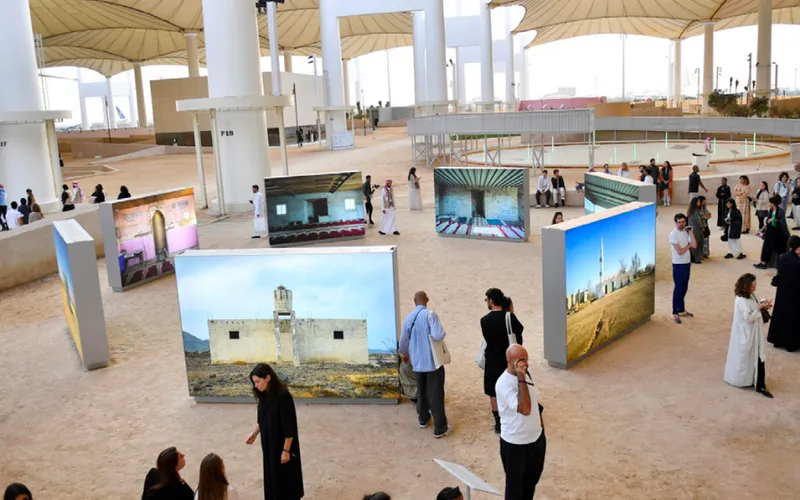
To count museum visitors without cameras, you lay a Mat 2.0 mat at the entrance and at gallery doors: it counts entries and exits, shows visitor numbers in real time and collects no personal data. The Islamic Arts Biennale in Jeddah used it for 1.5 million visitors over 4 months.
Updated 1 October 2026
Why does a museum need a visitor counter?
Ticketing tells you how many paid admissions you had. It does not count free entries, groups or how many people are in each room. A counter at each passage helps you:
- Respect room capacity and protect works from overcrowded galleries.
- Measure the success of a temporary exhibition against the permanent collection.
- Match front-of-house and warding staff to peak hours.
- Report to funders and patrons with reliable figures that compare year on year.
Why choose a mat over a camera?
In a museum, discretion and privacy matter as much as accuracy. The mat captures no images: there is nothing to blur and nothing stored about visitors.
| Criterion | 3D camera | Mat 2.0 |
|---|---|---|
| Visitor image | Captured, then processed | None |
| Installation | Ceiling mounting, cabling | Laid on the floor, mains socket |
| Calibration | Usually required | None |
| Relocation | Removal and re-cabling | Simply move the mat |
Our comparison counting mat vs 3D camera explains where each technology fits best. On data protection, see also our guide to people counting and GDPR.
How do you install counting in a museum?
- Equip the main entrance for overall visitor numbers, then the doors of the rooms or galleries you want to track.
- Lay the mats (1 to 10 per passage, 50 cm each) under a cover mat with at least 15 cm overlap. A custom cover can carry the exhibition’s visual identity.
- Plug in the gateway at a socket within 8 m of the mats. It connects over 4G, without touching the museum’s IT network.
- Follow visitor numbers in the Technis Counting app: real time, history and capacity alerts.
Setup takes around 10 minutes, with no technician.
What results in museums and exhibitions?
At the Islamic Arts Biennale in Jeddah (25 January to 25 May 2025), around fifty mats recorded 1.5 million visitors over 4 months across 5 galleries and 2 pavilions. The full case study is in Islamic Arts Biennale Jeddah: visitor numbers.
In Luxembourg, the National Museum of Natural History and the Neumünster Abbey have used the system for 6 years, which lets them compare seasons and exhibitions over the long term.
What accuracy and what data?
Accuracy is up to 98% in optimal conditions. Counts are hosted on AWS in Frankfurt (eu-central-1) and available on iOS, Android and the web. If the network drops, the gateway buffers the data.
How do you get started?
Museums usually equip their passages permanently: see the Mat 2.0 people counting mat page for prices and specifications. For a temporary exhibition, rental is quoted on request. To test it in your own galleries, request a pilot.
Frequently asked questions
How can a museum count visitors without cameras?
With a pressure-sensing mat laid on the floor of each passage. Mat 2.0 detects footsteps, tells entries from exits and calculates occupancy, with no images and no personal data.
Is a counting mat visible in an exhibition space?
The mat is 12 mm thick and sits under a cover mat, which can be custom-printed. Visitors see an entrance mat, not a sensor.
Can you track visitor numbers room by room?
Yes, by equipping the passages between rooms or galleries. In Jeddah, around fifty mats tracked 5 galleries and 2 pavilions for the full run of the Biennale.
Can a museum use Mat 2.0 over several years?
Yes. Luxembourg's National Museum of Natural History and the Neumünster Abbey have used the system for 6 years. The hardware carries a 2-year warranty.
Related reading
Islamic Arts Biennale Jeddah: gallery visitor counting
Islamic Arts Biennale Jeddah 2025: around 50 people-counting mats across 5 galleries and 2 pavilions, 1.5 million visitors over 4 months.
→Counting mat or 3D camera: which should you choose?
Footfall camera (3D) or counting mat? Accuracy, privacy, installation and outdoor use: an objective comparison to help you choose the right people counting system.
→Counting mat or infrared beam: which should you choose?
Infrared beam or counting mat? Passage width, side-by-side crowds, direction and cost: how to choose the right people counter for your entrance.
→People counting and GDPR: what are your obligations?
Cameras, Wi-Fi, floor sensors: which people counting methods process personal data under the GDPR and Switzerland's nLPD, and which do not?
→Try Mat 2.0 at your next event.
A guided pilot: installation, live data and a full report. Then you choose: buy or subscribe.